
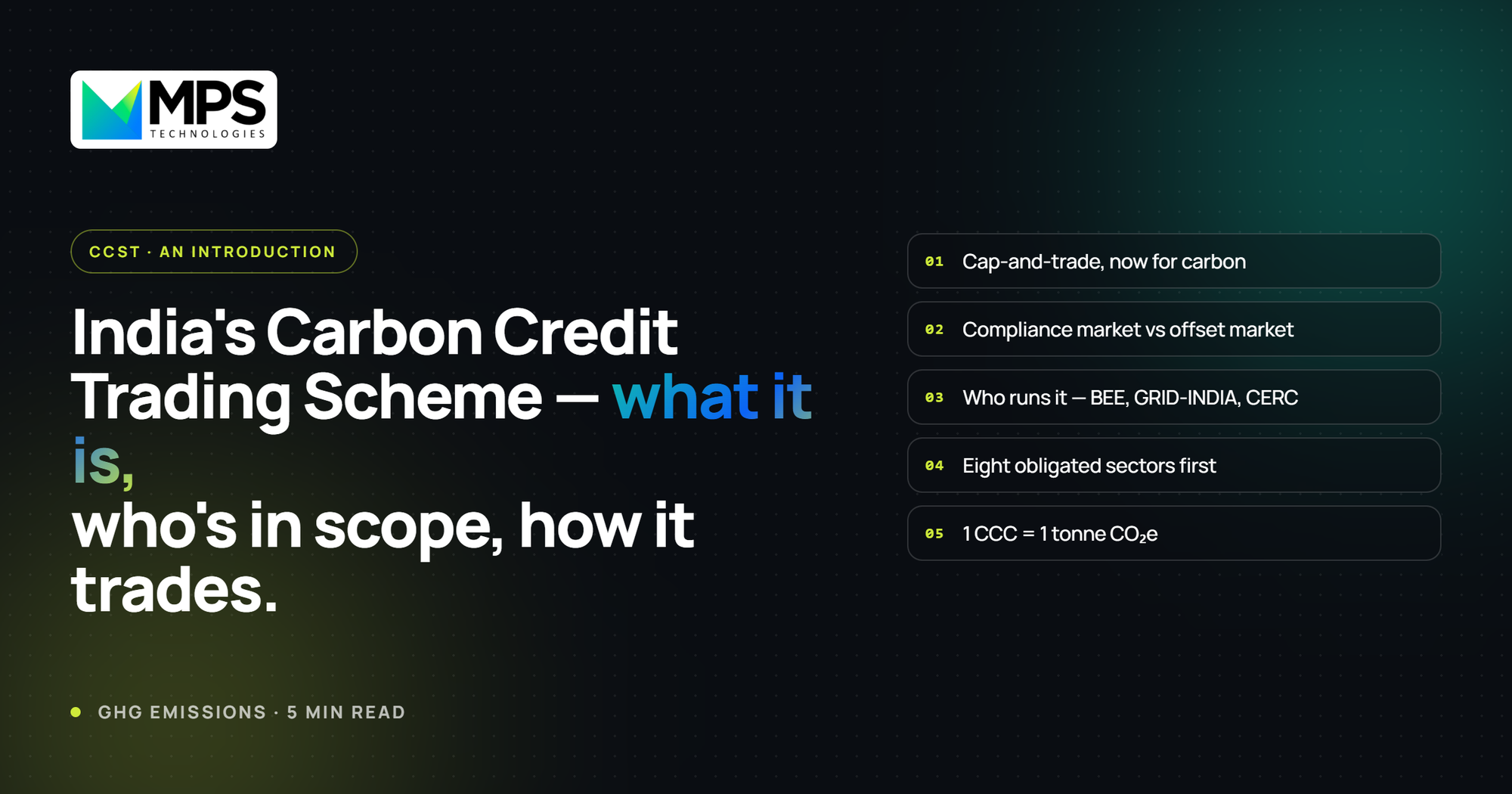
India officially entered the world of carbon markets in 2023. The Carbon Credit Trading Scheme — known as CCST — is India's first structured, government-backed framework for buying and selling carbon credits. It is built on the Energy Conservation (Amendment) Act, 2022 and marks a significant shift in how India plans to meet its climate commitments under the Paris Agreement.
If you manage sustainability, EHS (Environment, Health & Safety), or finance at a manufacturing or industrial company, CCST is something you will need to understand — because it is coming for obligated entities, and it will have real financial consequences.
This article explains what CCST is, how it works, who is affected, and what companies should be doing right now.
What Is CCST?
The Carbon Credit Trading Scheme is a market-based mechanism where companies that reduce their greenhouse gas (GHG) emissions below a set threshold earn carbon credits. Companies that exceed their threshold must buy credits from those who have surplus.
Think of it like a cap-and-trade system. The government sets a carbon "cap" for each sector. Companies below the cap earn credits they can sell. Companies above the cap must buy credits — or pay a penalty.
The scheme is notified under the Energy Conservation (Amendment) Act, 2022, which expanded BEE's (Bureau of Energy Efficiency) mandate beyond energy to include carbon. The Ministry of Power and Ministry of Environment, Forest and Climate Change (MoEFCC) are both involved.
Two Tracks: Compliance Market vs. Offset Market
CCST has two distinct tracks. It is important to understand both.
Track 1 — Compliance Market (Obligated Entities)
This is mandatory. Sectors and entities designated by the government as "obligated" will receive emission intensity targets. They must either meet the target or purchase credits to cover the shortfall.
If a company reduces emissions beyond its target, it earns tradeable carbon credits. If it falls short, it must buy credits from the exchange or from other eligible entities.
Track 2 — Offset Market (Voluntary Participants)
This is open to entities not covered under the compliance track. Businesses, farms, forestry projects, and others can voluntarily register emission reduction activities. If verified, they receive carbon credits they can sell to obligated entities or trade on the market.
This is an opportunity for smaller businesses, renewable energy developers, and Agri-sector companies to generate additional revenue from verified green activities.
Who Is Running CCST?
Three bodies are central to how CCST operates:
Bureau of Energy Efficiency (BEE) — Acts as the Administrator. BEE sets targets, accredits verifiers, registers projects, and maintains the carbon credit registry. BEE was already running the Perform, Achieve and Trade (PAT) scheme for energy efficiency — CCST builds on that experience.
Grid Controller of India (GRID-INDIA) — Acts as the Administrator for the compliance market. GRID-INDIA manages the actual trading of carbon credit certificates on power exchanges.
Central Electricity Regulatory Commission (CERC) — Regulates the trading process, sets market rules, and ensures fair price discovery.
MoEFCC and Ministry of Power — Provide joint oversight and policy direction. Both ministries notified the scheme jointly in June 2023.
Which Sectors Are Affected?
The compliance market initially targets energy-intensive sectors. Based on regulatory documents and BEE consultation papers, the sectors being considered for obligated status include:
- Aluminum
- Cement
- Chlor-alkali
- Fertilizers
- Iron and steel
- Pulp and paper
- Petrochemicals and refining
- Textiles
These are largely the same sectors covered under BEE's PAT scheme. CCST essentially extends PAT logic — from energy efficiency targets to carbon emission intensity targets.
Over time, more sectors are expected to be brought under the compliance track. The scheme is designed to expand in phases.
What Are "Obligated Entities"?
An obligated entity is a company or facility that the government formally designates as being subject to CCST compliance requirements. Designation is based on sector type and scale (typically energy consumption or production output thresholds).
If you are an obligated entity:
- You receive an annual emission intensity target
- You are registered in the national carbon registry
- You must report verified emissions data each year
- You must surrender carbon credits equal to your shortfall (or earn surplus credits you can trade)
If you are not yet an obligated entity, you can still participate voluntarily in the offset market — and earn credits for verified reductions.
What Is a Carbon Credit Certificate?
Under CCST, a carbon credit is represented as a Carbon Credit Certificate (CCC). One CCC equals one tonne of CO₂ equivalent (tCO₂e) reduced or avoided.
CCCs are:
- Issued by BEE upon verification of emission reductions
- Tradeable on designated power exchanges
- Valid for a defined period (subject to regulations)
- Retired (cancelled) once used for compliance
The price of CCCs is determined by market forces on the exchange — which means a company's financial exposure under CCST depends partly on market dynamics, not just its own performance.
How Does Emissions Verification Work?
This is where many companies are unprepared.
To earn credits or demonstrate compliance, a company's emission reductions must be verified by an accredited third-party agency. This verification is based on actual measured data — energy consumption, fuel use, process emissions, production output.
The verification process requires:
- Baseline emission intensity data (established by BEE)
- Annual reported emission intensity (from your own records)
- Third-party audit of data quality and measurement methodology
If your data is inaccurate, inconsistently recorded, or based on estimates rather than measurements, you will have trouble getting credits verified — and may face compliance shortfalls you didn't anticipate.
CCST vs. PAT Scheme: What's the Difference?
BEE's PAT (Perform, Achieve and Trade) scheme has been running since 2012. Many industrial companies are familiar with it. CCST is different in a few important ways:
PAT focuses on specific energy consumption (SEC) — how much energy you use per unit of output. CCST focuses on carbon emission intensity — how much CO₂ equivalent you emit per unit of output.
PAT issues Energy Saving Certificates (ESCerts). CCST issues Carbon Credit Certificates (CCCs). Both are tradeable, but they are separate instruments.
Over time, the government plans to integrate or align these schemes. But for now, companies may need to track and report both energy efficiency and carbon intensity data simultaneously.
Where MPS Fits In
MPS Technologies is an IoT-based energy and resource monitoring platform. We are not carbon verifiers, CCST consultants, or compliance auditors. But we do something that matters enormously for CCST readiness — we help companies get their data right.
Here is the problem we see at many industrial facilities: emission intensity calculations depend on accurate, continuous measurement of energy and fuel consumption — broken down by process, unit, and shift. Most companies today rely on manual logs, monthly utility bills, or aggregated meter readings. That data is not granular enough for CCST verification.
What MPS can help with:
Sub-metering and real-time monitoring — We deploy IoT sensors and smart meters at the equipment and process level. You get continuous, timestamped energy consumption data instead of estimated averages.
Multi-fuel tracking — CCST requires tracking all emission sources — electricity, diesel, furnace oil, natural gas, process gases. MPS platforms can consolidate these into a single dashboard.
Baseline data preparation — Before you can know if you've improved, you need a reliable baseline. MPS helps establish that baseline with actual measured data, not estimates.
Data audit trails — When a third-party verifier comes in, they need to trace data back to instruments. MPS platforms maintain instrument-level logs with timestamps — exactly the kind of evidence verification agencies look for.
If your facility is in one of the obligated sectors, the question is not whether you will need this data — it is whether you will have it ready when it is asked for.
What Should Companies Do Right Now?
CCST is still being phased in. Obligated entity designations, sector-specific targets, and final trading rules are being finalized. But that is not a reason to wait.
Step 1 — Understand your sector status. Check whether your sector is on the list of sectors being considered for the compliance market. Follow BEE notifications and consultation papers.
Step 2 — Map your emission sources. Know what you are emitting and from where. Electricity consumption, fuel combustion, process emissions — map all sources.
Step 3 — Assess your data quality. Can you produce monthly or quarterly energy and fuel consumption data per production unit, with supporting meter records? If not, that is a gap to fix.
Step 4 — Explore offset market opportunities. If you are not an obligated entity, you may still be able to generate credits through verified reductions — particularly if you are investing in energy efficiency or renewable energy.
Step 5 — Talk to an accredited verification agency. MPS is not a verification agency. But we can help you have the data infrastructure in place so that when you do engage one, the process goes smoothly.